
 By
By TL;DR
If you are trying to build an upper body workout for beginners, you do not need machines or weights to start seeing progress. Your own body weight is enough to create resistance if you use it properly and stay consistent. Most beginners struggle not because the exercises are wrong, but because they are done without clear form or without any plan to make them gradually harder. Upper body strength develops slowly, and that can feel frustrating, but it responds well to simple movements done well over time. This guide walks through five exercises, how to do them properly, and how to think about improving them without overcomplicating things.
Why Upper Body Training Matters More Than You Think
When people start working out, there is often a bias toward visible results. That usually means abs or weight loss. Upper body training tends to get treated as optional unless someone specifically wants bigger arms or shoulders.
But most evidence points toward upper body strength playing a much broader role. It affects posture, reduces strain on the neck and lower back, and makes everyday tasks easier in ways that are not obvious until you notice the difference. Carrying groceries, sitting at a desk for long hours, even how you hold your phone all depend on muscles that most beginners have not trained deliberately.
There is also a structural aspect to it. If your upper body is weak, your body compensates. Shoulders roll forward, the neck starts doing more work than it should, and small aches become more common. Strength does not fix everything, but it gives your body more margin to handle daily stress.
That said, the goal here is not to chase muscle for the sake of appearance. It is to build a base that actually supports how your body moves.
A Note on Progress That Most Beginners Miss
Before getting into the exercises, there is one idea that matters more than the specific movements. It is the idea of gradually making things harder over time.
This is often called progressive overload, but the concept is simpler than it sounds. Your body adapts to what you repeatedly ask it to do. If the demand stays the same, the adaptation slows down. If the demand increases slowly, your body keeps responding.
Think of it like carrying a bag. If you carry the same light bag every day, it never feels heavy after a point. But if the weight increases little by little, your body keeps adjusting.
With body weight exercises, you do not increase weight by adding plates. You increase difficulty by adjusting angles, slowing down the movement, adding pauses, or increasing repetitions. This becomes important once the basic version of an exercise starts to feel manageable.
The Exercises
1. Incline Push Ups

This is usually the most practical starting point. A standard push up can be too difficult for many beginners, which leads to poor form or avoiding the movement altogether.
Instead, place your hands on an elevated surface like a table, bench, or even a wall if needed. The higher your hands are, the easier the movement becomes.
Position your hands slightly wider than shoulder width. Keep your body in a straight line from head to heels. As you lower yourself, your elbows should move at a slight angle rather than flaring straight out to the sides. Lower your chest toward the surface, then push back up.
Start with 3 sets of 8 to 12 repetitions.
The most common mistake here is letting the hips sag or the lower back arch excessively. It helps to think of your body as a straight plank that moves as one piece. Another common issue is rushing through the movement. Slowing down the lowering phase makes a noticeable difference.
As this becomes easier, you can lower the height of the surface over time until you are doing push ups closer to the floor.
2. Knee Push Ups
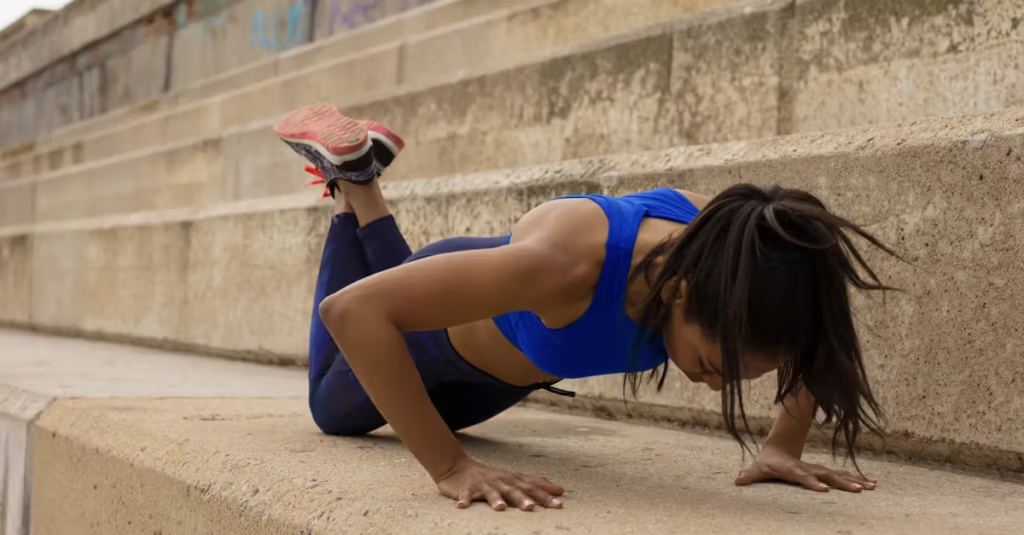
This is a step closer to a full push up, but still manageable for most beginners.
Start in a push up position, but with your knees on the ground instead of your feet. Your body should still form a straight line from your head to your knees.
Lower your chest toward the floor in a controlled way, then push back up. Keep your core engaged so your hips do not drop or rise during the movement.
Aim for 3 sets of 6 to 10 repetitions.
One mistake that shows up often is treating this as a separate exercise rather than a modified push up. The mechanics should stay the same. Only the leverage has changed. Another issue is cutting the range of motion short by not lowering enough. Try to move through a full range even if that means doing fewer repetitions.
Over time, this builds the strength needed to transition into full push ups.
3. Plank Shoulder Taps
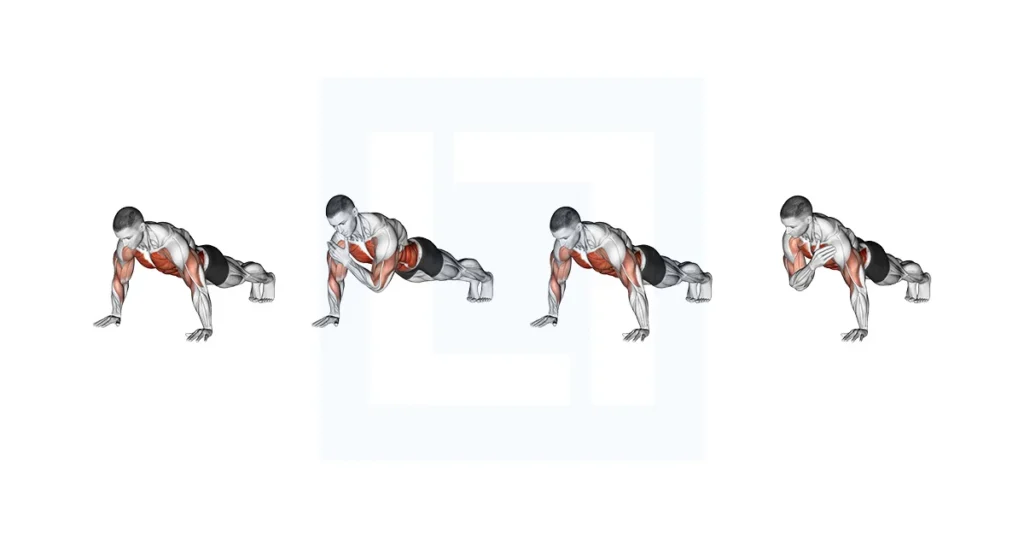
This exercise works more than just your arms. It also trains stability through your shoulders and core, which is something beginners often overlook.
Start in a high plank position with your hands under your shoulders and your feet slightly wider than usual. From here, lift one hand and tap the opposite shoulder, then return it to the ground. Alternate sides.
Go for 3 sets of 10 to 16 taps per side.
The key here is controlling movement rather than completing taps quickly. Your hips should stay as stable as possible. If they are shifting side to side, it usually means the movement is being rushed or the stance is too narrow.
Think of balancing a glass of water on your lower back. The goal is to keep it from spilling. That mental image tends to help people slow down and control the motion better.
4. Wall Supported Pike Push Ups
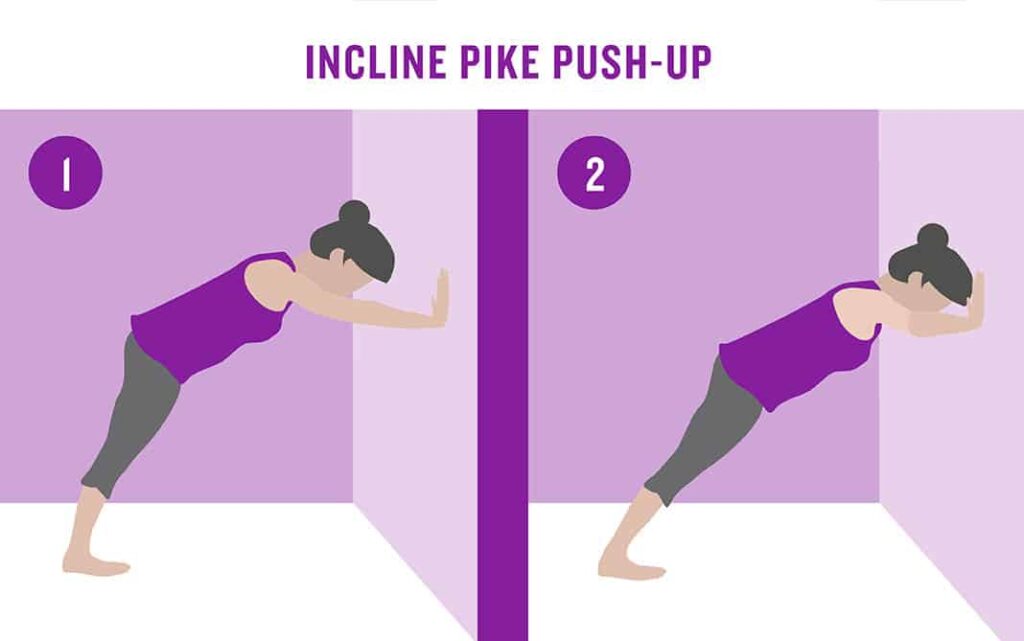
This movement targets the shoulders more directly, which is something regular push ups do not fully cover.
Start by placing your feet on the ground and your hands on the floor, forming an inverted V shape with your body. Your hips should be pushed up high. If needed, you can use a wall behind you for balance by lightly resting your feet against it.
From this position, bend your arms and lower your head toward the floor between your hands, then push back up.
Do 3 sets of 6 to 10 repetitions.
A common mistake is turning this into a regular push up by dropping the hips. The angle of your body is what shifts the focus toward the shoulders. Keeping your hips high is what makes the exercise effective.
If this feels too difficult, you can bend your knees slightly to reduce the load.
5. Bench Dips or Chair Dips

This is one of the few body weight exercises that directly targets the back of the arms.
Sit on the edge of a chair or bench and place your hands next to your hips. Slide your body forward so your hips come off the surface, supporting your weight with your arms.
Lower your body by bending your elbows until your upper arms are roughly parallel to the floor, then push back up.
Perform 3 sets of 8 to 12 repetitions.
The most common mistake is going too deep into the movement, which can place unnecessary stress on the shoulders. Staying within a comfortable range where you feel your arms working without joint discomfort is more important.
Another issue is letting the shoulders roll forward. Keeping your chest slightly open and your shoulders pulled back helps maintain better positioning.
Where Beginners Usually Get Stuck
A pattern shows up with almost everyone starting an upper body workout for beginners. The exercises are not the problem. The way they are approached is.
One issue is doing the same number of repetitions every session without any change. Over time, your body adapts and the stimulus becomes weaker. This is where small adjustments matter. Adding a few repetitions, slowing down the movement, or reducing support can keep progress moving.
Another issue is focusing only on finishing the sets. That often leads to rushing through movements with poor form. Muscles respond to tension, not just movement. If the form breaks down, the tension shifts away from the target muscles.
There is also the expectation problem. Upper body strength, especially for beginners, does not build quickly. Compared to lower body training, it can feel slower and more inconsistent. That does not mean it is not working. It just takes longer to notice.
How to Think About Progress Without Overcomplicating It
You do not need a complex system to improve. What matters is paying attention to small changes over time.
If an exercise starts to feel easier, that is your signal to adjust something. Maybe you increase repetitions slightly. Maybe you slow down the lowering phase. Maybe you move to a harder variation.
Research tends to show that consistent gradual increases in difficulty are what drive adaptation. Not dramatic jumps, just steady changes that your body has to respond to.
If you ever feel pain that seems sharp or unusual, it is worth stepping back and, if needed, checking with a professional. That is less about being cautious and more about avoiding setbacks that slow everything down.
Closing Thoughts
Most people expect upper body strength to show up quickly if they are doing the right exercises. It usually does not. What happens instead is quieter. Movements feel a bit more controlled. Repetitions that once felt difficult become manageable. Posture improves without much attention.
It does not feel dramatic in the moment. But over time, those small shifts add up in a way that is hard to fake or rush.