

 By
By TL;DR
Journaling for mental health is less about documenting your life and more about changing your relationship to your thoughts. Research suggests that writing things down can reduce emotional intensity, improve clarity, and help the brain process experiences more effectively. It works not because it is expressive in a vague sense, but because it forces thoughts into structure, where they become easier to examine. There is no single correct way to journal, and most of the friction people feel comes from trying to do it the right way instead of doing it honestly. The usefulness of journaling tends to reveal itself gradually, often in ways that are subtle at first and only obvious in hindsight.
What Journaling Is Actually Doing in the Brain

At a surface level, journaling looks simple. You write down what you are thinking or feeling. But something more specific is happening underneath that.
Thoughts, especially anxious or emotionally loaded ones, tend to exist in a kind of unfinished state. They loop, repeat, and expand without resolving. Thinking is fast and abstract. It does not require structure, which is why it can keep going without landing anywhere.
Writing interrupts that.
When you try to put a thought into words on a page, it has to slow down and take shape. Vague impressions turn into sentences. Emotional noise becomes something more concrete. And once something is concrete, it becomes easier to examine rather than just react to.
- Thoughts move from scattered to structured
- Emotional intensity often softens once it is clearly expressed
There is a body of research around expressive writing, often associated with psychologist James W. Pennebaker, showing that people who regularly write about their thoughts and experiences tend to show improvements in emotional processing and even some physical health markers. The mechanism is less about emotional release and more about organization. Structuring experience into language reduces the cognitive weight it carries.
Writing does not remove problems. It changes how they exist in your mind.
Why Thinking Alone Does Not Usually Work
If journaling helps, it raises a natural question. Why does thinking through things not do the same?
The issue is that thinking tends to stay inside the same loops that created the problem. When something is bothering you, your mind circles around familiar interpretations. There is movement, but not much changes.
Writing introduces a constraint. You cannot hold multiple half formed thoughts at once. You have to follow one idea long enough to finish it. And in doing that, inconsistencies start to show.
- What felt overwhelming becomes more specific
- What felt certain begins to look more like interpretation
There is a quiet shift here, from being inside the thought to observing it. That shift is where most of the benefit comes from.
Different Ways to Journal and Why They Feel Different

One reason journaling feels confusing is the assumption that there is only one way to do it. In reality, people tend to move between different styles depending on what is going on internally.
Sometimes writing is unfiltered and loose. Just putting down whatever comes to mind. This tends to help when thoughts feel crowded or tangled.
Other times it is more structured. Writing about a specific situation and how it was interpreted. Over time, patterns begin to show up in how situations are processed.
There is also a quieter, more reflective approach that focuses on internal states. Trying to understand what you are feeling and where it might be coming from.
- Clearing thoughts
- Noticing patterns
- Understanding emotional states
None of these approaches are better than the others. They simply serve different purposes, often without needing to be labeled.
The Problem With Trying to Do It Right
A lot of resistance to journaling comes from a subtle pressure to do it correctly. To write something insightful or meaningful.
That pressure usually interferes with the process.
If you try to sound thoughtful, you begin editing as you write. And once editing starts, honesty fades. You end up writing what sounds reasonable instead of what feels true.
Journaling works best when it is allowed to be slightly unrefined. Thoughts do not need to be complete before they are written.
There is also the question of audience. Even when no one else will read it, people often write as if someone might.
- Writing becomes more guarded
- Certain thoughts get softened or avoided
Simply noticing this tendency can change the way you write.
What to Write When You Have No Idea

The blank page often feels like the hardest part. But the problem is rarely a lack of thoughts. It is more often uncertainty about where to begin.
A starting point does not need to be deep. It can be something simple or slightly unresolved.
- What has been on your mind today
- Something that felt off but unclear
- A thought that keeps returning
Once writing begins, it usually moves on its own. The first sentence is rarely the point. It just opens things up.
There are also moments when nothing seems to come. Writing about that absence can still be enough. There is often more underneath it than it initially appears.
Why It Can Feel Uncomfortable at First
Journaling is often described as relieving, but that is not always how it feels at the start.
Sometimes writing makes things feel more real. Thoughts that were vague become defined. Feelings move into focus. That can temporarily increase intensity.
This does not mean something is wrong. It reflects a shift in attention.
There is also a kind of honesty that writing brings. Certain patterns become harder to ignore when they appear repeatedly on the page.
- The same concerns show up again
- The same interpretations repeat
- Certain reactions become more visible
Over time, repetition stands out. And once something is clearly seen, it is harder to dismiss.
The Subtle Changes That Happen Over Time

The effects of journaling tend to be gradual rather than dramatic.
A thought that once spiraled for hours may settle more quickly. A reaction may feel slightly less automatic. There is often a bit more space between what happens and how it is interpreted.
- Less immediate reactivity
- More awareness of patterns
- Slight distance from intense thoughts
You may also notice that certain assumptions feel less fixed. Not because they have been disproven, but because they have been examined enough times to feel less solid.
Recognition changes things. When a pattern becomes familiar, it tends to feel less overwhelming.
Where Journaling Fits and Where It Does Not
Journaling is a tool, not a complete answer.
It can help with clarity, processing, and awareness. But it does not replace external change where that is needed.
There are limits to what can be worked through alone. In some cases, especially when patterns feel deeply rooted, speaking with someone trained in this area can add something writing alone cannot provide.
What journaling does well is create space. A place where thoughts can exist without immediate reaction.
A Different Relationship With Your Own Mind
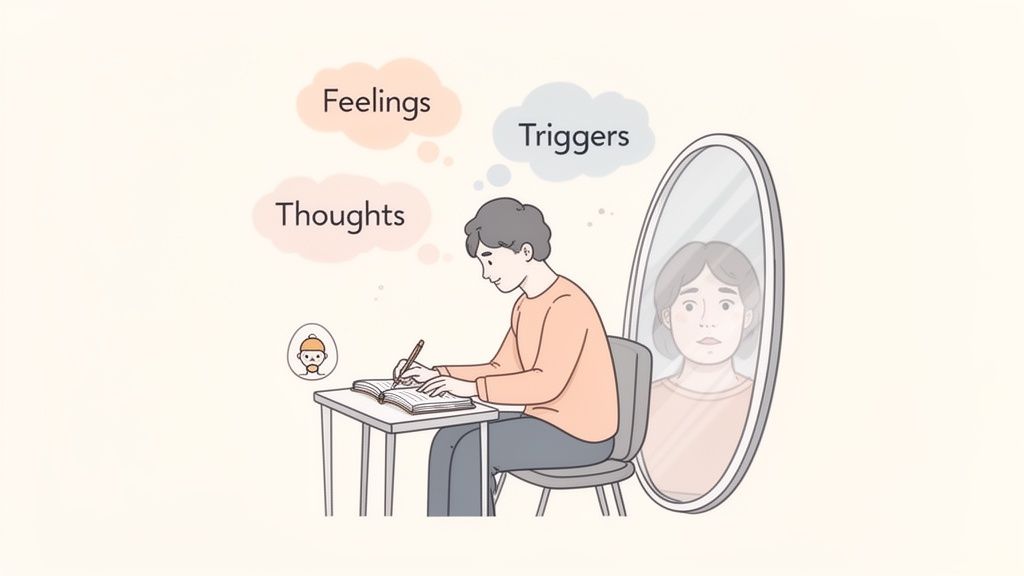
Over time, the shift is less about what gets written and more about how thoughts are experienced.
There is a gradual movement from being inside every thought to being aware of it as it happens. Not distant, but not fully absorbed either.
Difficult thoughts still appear. That part does not change. What changes is how much space they take up.
- More recognizable
- Less consuming
- Easier to sit with
The change is quiet. It shows up in small differences in how things are processed and how long they stay.
Journaling does not create a different mind. It makes the one you already have a little easier to live with.