

 By
By TL;DR
Social anxiety is more than shyness. It is a specific pattern of fear centered on being judged, embarrassed, or rejected in social situations, and it tends to run deeper than most people realize. The anxiety often kicks in before the event, stays elevated during it, and lingers long after through replaying what was said or done. Understanding what is actually happening in the brain and body during social anxiety makes it easier to work with, rather than just push through. This article breaks down what social anxiety is, why it happens, and what kinds of approaches tend to help over time.
What Social Anxiety Actually Is

Social anxiety gets described as extreme shyness a lot, but that framing misses the point. Shyness is a temperament trait. Social anxiety is a fear response that gets activated specifically around social evaluation. The person experiencing it is not just quiet or reserved. They are genuinely afraid of being perceived negatively, and that fear shapes their thinking and behavior in ways that can be hard to explain to someone who has never felt it.
The fear itself usually clusters around a few core concerns:
- Saying something stupid or coming across as awkward
- Embarrassing yourself visibly in front of others
- Being noticeably nervous and having people pick up on it
- Being judged, disliked, or rejected in some way
These fears do not have to be rational to feel overwhelming. The brain is not running a logic check when it fires off anxiety. It is responding to a perceived threat, and in this case the threat is social judgment.
What makes social anxiety distinct from general nervousness is the anticipatory component. A person with social anxiety does not just feel anxious during a dinner party or a presentation. They start dreading it days in advance. They rehearse conversations. They think through every possible way things could go wrong. And after the event, they often spend hours running through what happened, picking apart things they said or the way they came across. That post-event analysis is one of the more exhausting parts of it that rarely gets discussed.
The Psychology Behind It
The psychological model that tends to explain social anxiety best involves something called the self as a social object. When social anxiety is active, the person shifts their attention inward in a very particular way. They start monitoring themselves from an external perspective, essentially imagining how they appear to others and filling in the blanks with the worst possible interpretation.
This internal observer becomes extremely critical. A voice shakes slightly while speaking and the person immediately assumes everyone noticed and judged them. A joke does not land and they conclude that people find them annoying or boring. The actual evidence for these conclusions rarely matters because the mind is not gathering evidence. It is confirming what it already fears.
Research tends to show that people with social anxiety consistently overestimate how much others are paying attention to their flaws and underestimate how negatively others actually perceive them. In reality, most people are far too absorbed in their own experience to scrutinize others in the way social anxiety assumes. But knowing this intellectually and feeling it as true are two different things, and that gap is part of what makes social anxiety so frustrating to live with.
There is also a safety behavior pattern worth understanding. To manage the fear of being judged, people with social anxiety often develop subtle habits designed to prevent worst-case scenarios:
- Avoiding eye contact to reduce the sense of exposure
- Rehearsing what to say before saying it
- Staying quiet rather than risking saying the wrong thing
- Leaving situations earlier than they would like
These behaviors make sense in the moment, but they tend to maintain the anxiety over time because the person never gets the chance to find out that the feared outcome would not have happened anyway.
What Social Anxiety Feels Like in the Body
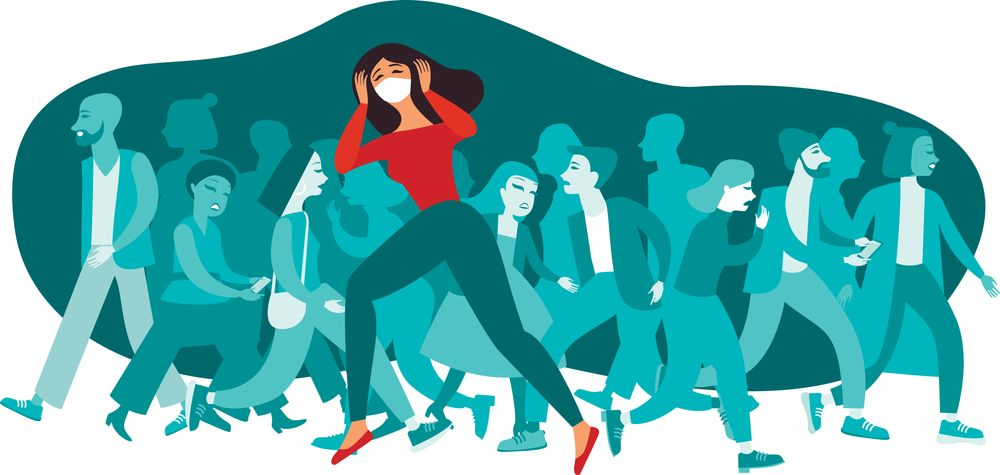
The physical side of social anxiety is significant and often creates its own loop of anxiety. Before or during a social situation, the body can respond with:
- A racing or pounding heart
- Flushing or visible blushing
- Sweating, sometimes noticeably
- A tight or hollow feeling in the chest
- Dry mouth or a trembling voice
These are all normal stress responses, but for someone with social anxiety they become evidence of the very thing they are afraid of: being visibly nervous.
This creates what is sometimes called the anxiety spiral. The person enters a social situation already on edge. They notice their heart racing. They become more anxious because they are now worried about being visibly anxious. That additional anxiety makes the physical symptoms worse. The symptoms confirm the fear. And so on.
Blushing is a particularly common source of distress in social anxiety, partly because it is one of the few physiological responses that is genuinely visible to others. Most physical anxiety symptoms are invisible from the outside, but the perception that blushing signals something to others feeds directly into the core fear. What is worth knowing is that blushing tends to be far less noticeable to observers than it feels from the inside, and most people do not interpret it the way social anxiety predicts they will.
Why Some People Develop Social Anxiety and Others Do Not
There is no single cause. Like most things in psychology, it tends to be a combination of factors that interact over time.
Genetics plays a role. Social anxiety does run in families, and there is evidence suggesting some people are born with a nervous system that is more reactive to social threat than others. But biology is not destiny. It sets a kind of sensitivity level, not a fixed outcome.
Early experiences shape a great deal. Being bullied, mocked, or humiliated as a child, especially in social settings, can leave a lasting imprint on how the brain evaluates social risk. Parents who were themselves socially anxious or who modeled avoidance can also contribute, not through intention but through the everyday ways anxiety gets communicated and responded to.
Cultural context matters more than people give it credit for. Environments where social performance is heavily evaluated, where standing out is risky, or where making mistakes is treated as shameful tend to produce more social anxiety than environments where failure is normalized and difference is tolerated. This is not about blaming culture but about recognizing that anxiety does not form in a vacuum.
How Social Anxiety Tends to Get Better

The most well-studied approach for social anxiety involves gradually confronting feared situations rather than avoiding them. This is not the same as forcing yourself into overwhelming situations and white-knuckling through them. The idea is more careful than that: progressively exposing yourself to the feared situations while learning to tolerate the discomfort rather than escaping it.
Over time, repeated exposure tends to retrain the brain’s threat response. The situation stops signaling danger because danger never arrived. But this takes time and consistency, and it works best when the person is also working on the cognitive patterns underneath, not just the behavior on the surface.
The cognitive side of recovery involves learning to notice and question the assumptions social anxiety generates. Not by talking yourself out of them with logic, but by treating them as hypotheses rather than facts. A few questions that tend to help with this:
- What is the actual evidence for what I am assuming?
- What is the most realistic interpretation of what just happened?
- How would I read this situation if it happened to someone I care about?
These are not tricks. They are habits of thought that take real practice to develop, and they tend to get more useful the more consistently they are applied.
There is also something to be said for understanding that discomfort in social situations does not have to be eliminated for life to improve significantly. The goal most frameworks point toward is not the absence of social anxiety but the ability to act in spite of it. The anxiety becomes something that is present without being in charge.
If the anxiety is significantly limiting daily life, a therapist who works with cognitive behavioral approaches can be genuinely helpful and is worth looking into.
The Relationship Between Avoidance and Anxiety
Avoidance is the thing that holds social anxiety in place more than anything else. It makes complete sense as a short-term strategy: if being around people is frightening, and avoiding people makes the fear go away, then avoiding people feels like the logical choice. The problem is that it teaches the brain nothing. The feared situation was avoided, so no new information was gathered, and the threat remains just as large as it was before.
What avoidance also does is gradually narrow the person’s world. The pattern tends to follow a recognizable path:
- Specific high-pressure events get avoided first
- Then social gatherings of most kinds start to feel too risky
- Then situations involving unfamiliar people get cut out
- Eventually, the range of situations that feel safe keeps shrinking while everything outside it feels increasingly threatening
This is not a character flaw. It is a completely predictable outcome of how fear learning works. But understanding it is useful because it reframes avoidance not as relief but as maintenance. Each avoided situation is not a win. It is a trade: short-term comfort for long-term entrenchment.
A Note on Living With It

Social anxiety exists on a spectrum. Many people live with a level of it that is manageable but persistent, something that occasionally limits them without defining their life in obvious ways. Others find it genuinely disabling in ways that affect their work, relationships, and sense of possibility.
Wherever someone falls on that spectrum, what tends to help is not treating social anxiety as something shameful or hidden. The instinct is often to keep it private, to perform confidence while the internal experience is very different. That performance is exhausting. Understanding what is happening and being reasonably honest about it, at least with yourself and perhaps with a few trusted people, tends to reduce the weight of it somewhat.
Social anxiety is, at its core, a response to the very real human need to belong and to be accepted. The fear of rejection is not irrational in an evolutionary sense. It is misfiring, pointing to threats that are not actually proportionate. That distinction matters not because it makes the anxiety easier to dismiss, but because it makes it easier to understand. And understanding something, even partially, tends to make it slightly less frightening.